One year on: The Drive Project roll-out across England and Wales

27th August 2026
 Skip to main content

27th August 2026

In July 2025, the Drive Partnership welcomed a four year investment into the national roll-out of the Drive Project – a co-ordinated multi-agency intervention for high-risk, high-harm and serial perpetrators of domestic abuse, with the core mission of increasing the safety and freedom of victim-survivors.
The Drive Partnership, formed by Respect, SafeLives, and Social Finance, first launched the Drive Project in 2016 with the ambition of turning the tide on domestic abuse and supporting victim-survivors, including children, to live free from harm. Since then, it has worked with over 8,200 perpetrators to reduce the risk that they pose and increase the safety of over 9,100 adult victim-survivors and more than 16,700 child victim-survivors. The national roll-out of the Drive Project aims to significantly increase this impact; reaching more perpetrators, and even more adult and child victim-survivors.
Investment into the Drive Project roll-out formed part of a broader range of measures within the Government’s Freedom from Violence and Abuse Strategy; located within its wider response to perpetrators, and alongside vital pillars focused on prevention and early intervention and support for victim-survivors. This marked a positive step within a wider, collective, and ongoing mission, with further progress to be made to respond effectively to all perpetrators and ensure all victim-survivors can be free from harm.
One year on, the Drive Partnership reflects on a year of progress, development, and collaboration to establish a consistent and evidence informed response to high-risk, high-harm and serial perpetrators to increase the safety of victims-survivors across England and Wales.
The Drive Project is delivered locally through multi-agency partnerships, including Police and Crime Commissioners (PCCs), specialist domestic abuse organisations, and close working with agencies such as police, housing, probation, and children’s social care. Through these partnerships, agencies and local specialist services work to disrupt, challenge and change perpetrator behaviour. At the same time, Independent Domestic Violence Advisors (IDVAs) and victim-survivor services provide separate but parallel support for victim-survivors, including children, in line with the Respect Standard.
The vast majority of the Government’s investment into the roll-out flows directly from the Home Office to PCCs, and then onto specialist services for the delivery of the Drive Project response to perpetrators. This includes the commissioning of parallel strands of work with victim-survivors, with additional funding for IDVA provision and ring-fenced budget for specialist by-and-for organisations and experts by experience.
The Drive Partnership provides central support for both the Police and Crime Commissioner teams commissioning the Drive Project and the service providers who are delivering. This support is provided from the early stages of procurement and mobilisation throughout ongoing service delivery. It includes training on the Drive Project delivery model, best practice in multi-agency working with high-harm, high-risk perpetrators, quality assurance, risk management, and safeguarding. The Drive Partnership also works closely with partners to tailor the Drive Project to the local area; ensuring it flexes to fit appropriately within local multi-agency systems, networks, and pathways in ways that can best meet local need and draw on local expertise.
As part of the preparation for new site launches over the past year, the Drive Partnership has been working closely with partners across a number of areas to provide this central role and support the safe and effective embedding of new Drive Project sites into local ecosystems.
Through close working and collaboration across services, the Drive Partnership is delighted to see 10 new Drive Project site areas launching across local areas in year one of the roll-out; bringing the total number of delivery areas to 15. Please see below details of both pre-existing sites and new site areas (regular updates will be available on the Drive Project page throughout roll-out).
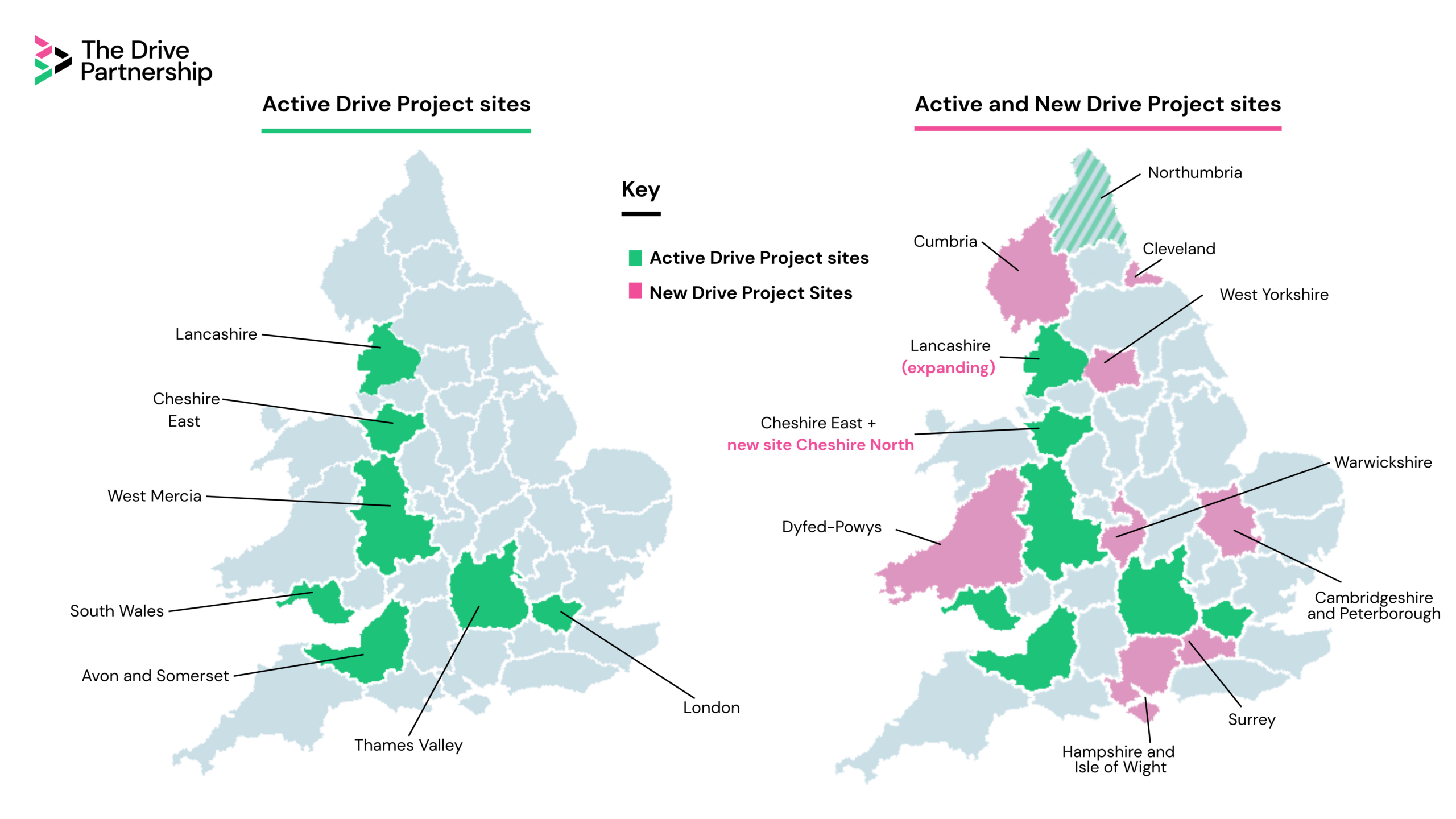
Please note: Northumbria delivers a regional model, evolved from the Drive Project, and continues to work with the Drive Partnership.
Reflecting on the launch of the new Drive Project sites, Shana Begum, SafeLives Pioneer, said: “As both a survivor and a professional in this sector, it is incredibly powerful to see this work come to life. I’ve long advocated to see this evidence-based programme across areas, and its success hinges on strong partnerships and a collective commitment to fully embedding it at a local level. Only by working together can we build a system that is truly accountable for survivor safety, supports healing from generational trauma, and fosters a more equitable society where those who harm are held accountable and given the opportunity to change old patterns, families are safer, and fewer lives are lost.”
Throughout the first year of roll-out, the Drive Partnership has been engaging with partners, stakeholders and broader networks to ensure that the Drive Project roll-out is embedded safely and effectively across all areas. This includes sharing information on the Drive Project model and gathering learning and insights from stakeholders to ensure that the Drive Project fits into and strengthens local service provision across new areas. It also involves gathering insight and learning on how the Drive Project roll out impacts on wider national ecosystems of services and responses for domestic abuse victim-survivors as well as identifying opportunities for the continuous development and evolution of the evidence-based model so that it plays an on-going role in addressing existing and emerging systemic gaps, contributing to the wider mission to end domestic abuse.
As part of this work, the Drive Partnership has hosted a series of information and engagement sessions with organisations and networks across and beyond the domestic abuse sector. These sessions seek to share information, gather insights, and hear feedback to support future development. This has included an evaluation webinar to build understanding of the Drive Project’s evidence base and connect stakeholders with evaluators. The webinar included presentations on the University of Bristol’s independent, three-year, evaluation of the Drive Project (2016-2019), including early sight of the new evaluation on the Drive Project, alongside the University of Suffolk’s evaluation of the Drive Partnership’s systems change impact (2021-2023).
While these engagement sessions are ongoing, key themes and feedback from sessions so far have already been fed back into the Drive Partnership’s wider work and planning for future roll-out, and will also inform the next phase of its engagement throughout year two. This is the beginning of ongoing, long-term engagement and collaboration in line with the Drive Project’s fundamental role as part of a coordinated community response to domestic abuse.
Hannah Candee, Programme Manager at the Drive Partnership, said: “We’re hugely appreciative to everyone who has given their time, shared their expertise and spoke so openly throughout these sessions. The opportunity to hear from such a wide range of experiences and perspectives has been incredibly valuable. We are looking forward to building on this and collaborating further with partners across the sector to make both the Drive Project and all of our work towards ending domestic abuse stronger.”
The national roll-out of the Drive Project has been the culmination of a decade of cross-sector collaboration on best practice development, evidence building, and advocacy across delivery partners, funders, academics, pioneers with lived experience, and many more.
Looking ahead to the remainder of roll-out, the Drive Partnership is committed to continuous collaboration and further development of the evidence-based model to best contribute to the wider mission to end domestic abuse. This will include focus across continuous model and practice development to best address systemic gaps for under-served communities, meet the wide range of needs of adult and child victim-survivors, and respond effectively to new and emerging forms of harm. The development of this work will be informed by engagement with existing and new partners, learning from the Drive Partnership’s National Systems Change work, and ongoing evidence-building.
As the Drive Project is one piece of a broader mission to end domestic abuse, the Drive Partnership is also committed to ongoing advocacy for wider systems change to improve responses to all perpetrators, and for sustainable, specialist service provision for victim-survivors. Reaching this milestone of the national roll-out of the Drive Project aligned with one of four key recommendations within the Drive Partnership’s Call for Further Action, which was developed with the input of a wide range of partners and supported by over 100 signatories, and the Drive Partnership will continue to pursue all of its recommendations, the wider sector’s urgent needs, and an effective national response to all perpetrators for the safety and freedom of all victim-survivors.
Kyla Kirkpatrick, Director of the Drive Partnership, said: “The roll-out of the Drive Project has marked an important milestone within the national response to perpetrators, and we’re incredibly grateful to our long-standing and new partners who are turning this opportunity into real change for victim-survivors.
This is one step within a wider, collective and ongoing mission, with much further to go to address ongoing systemic gaps and ensure that all victim-survivors, across all communities, can be safe from harm. We know that by working together across and beyond the domestic abuse sector, we can turn the tide on domestic abuse for all victim-survivors, for good.”